
Author Archives: Clerk

Epistle from Quakers in Belgium and Luxembourg 2026

RELIGIOUS SOCIETY OF FRIENDS (QUAKERS)
BELGIUM AND LUXEMBOURG YEARLY MEETING
Epistle
from the
Residential Yearly Meeting
May 22-24, 2026
Arend-Fixmer Centre “Les Etangs”
Medernach, Luxembourg

To Friends everywhere, we send loving greetings from the annual gathering of Quakers in Belgium and Luxembourg, held in peaceful wooded surroundings and blessed with glorious Spring weather. This was a historic occasion, being the very first time that the Yearly Meeting has ever been held in Luxembourg and not Belgium.

Thirty-four Friends and Attenders of the four BLYM worship groups gathered for a weekend of spiritual and practical discussions and Quaker worship, and were joined by guests including a representative of FWCC-EMES, a Friend visiting from German Yearly Meeting and Rhiannon Grant of Britain Yearly Meeting, who led us in discussions and workshops related to our Advices and Queries Project.

Joyful cries of “Great to finally meet you in real life!” were heard all around on the first evening of our gathering, as Friends who had only ever worshiped or conversed together online met each other for the first time in the flesh.

In the first evening’s epilogue, we were encouraged to imagine what we might do in the present in order to create a happy memory for the future. The task in the present moment for our Quaker community is to discern how to proceed with our Advices & Queries Project.

For many years we have sought guidance in the book of discipline of Britain Yearly Meeting, currently entitled Quaker Faith and Practice. In recent years we have begun to adopt additions to this text based on our own experience of living as Quakers in Belgium and Luxembourg, and have already produced our own supplement to the British publication.

Like many other Friends, we follow the practice of using Advices & Queries as a succinct form of guidance to help us live our Testimonies. In our sessions and workshops this weekend and in the two online sessions which were held in advance, we have begun to explore the possibility of creating our own version of Advices & Queries to better reflect our own specific experience.

This weekend we have looked at that possibility more closely. Guided by Rhiannon, through discussions in small groups and in plenary sessions, and also through creative workshops, we have  explored what Advices & Queries mean to us and what a future version might include. One group spent time responding to No. 42 of Advices & Queries through art (see below), while another group created a short spontaneous video on the theme.

The complexity of this process revealed itself throughout the course of the gathering. For many Friends, religious language is associated with painful memories from their previous faith communities. We have realised that many of us (unconsciously) edit the existing Advices & Queries when we read them – we accept the text as we would receive an already loaded dinner plate, then we push certain items out of the way that are not to our taste, before eating.

At the same time, Friends feel anxiety over excluding the religious experiences of others. We have a tendency, when in doubt, to retreat back into silence. But in keeping with George Fox’s challenge: “What canst thou say?”, we have discerned to go forward with our project. We accept the challenge: to choose, claim, and use words that fit together to create a new way to engage with the “Absolute Perhaps” of Ben Pink Dandelion.

Through our sessions together, we have become aware of the size of the challenge. Different paths and different histories have brought us to Quakerism – some were born into the tradition, some have “shopped around” for a spiritual community. How do we speak with one voice? How do we reflect the diversity of languages and cultures within our Yearly Meeting? How do we – so many of us transplanted from other cultures and countries – speak on behalf of “Belgian” and “Luxembourgish” Friends?

What tone will we adopt – formal, informal? Active or passive voice? Addressing Friends in second person singular or first person plural? Can we fashion a new version that acknowledges doubt and the dark night of the soul, that reflects our awareness that all compassion for others starts from acceptance of self?

Let us create a text that sparkles. Let us find words that delight us, inspire us and light a spark within us. Let us be prophets of joy.

As our gathering – so full of sweet moments to savour – comes to an end on this day of Pentecost, our hope is that the Holy Spirit will light a small flame in our hearts and in our community. Embracing the spirit of Ubuntu – often translated as I am because we are – we understand that God is a verb. How do we bring a divine vision to all that we do, see God in our relationship to all things?

We have heard that becoming a Quaker is stepping into the future. May it be so.

Signed in and on behalf of Belgium and Luxembourg Yearly Meeting
Paul Holdsworth, Co-Clerk ; Nick Rendle, Co-Clerk
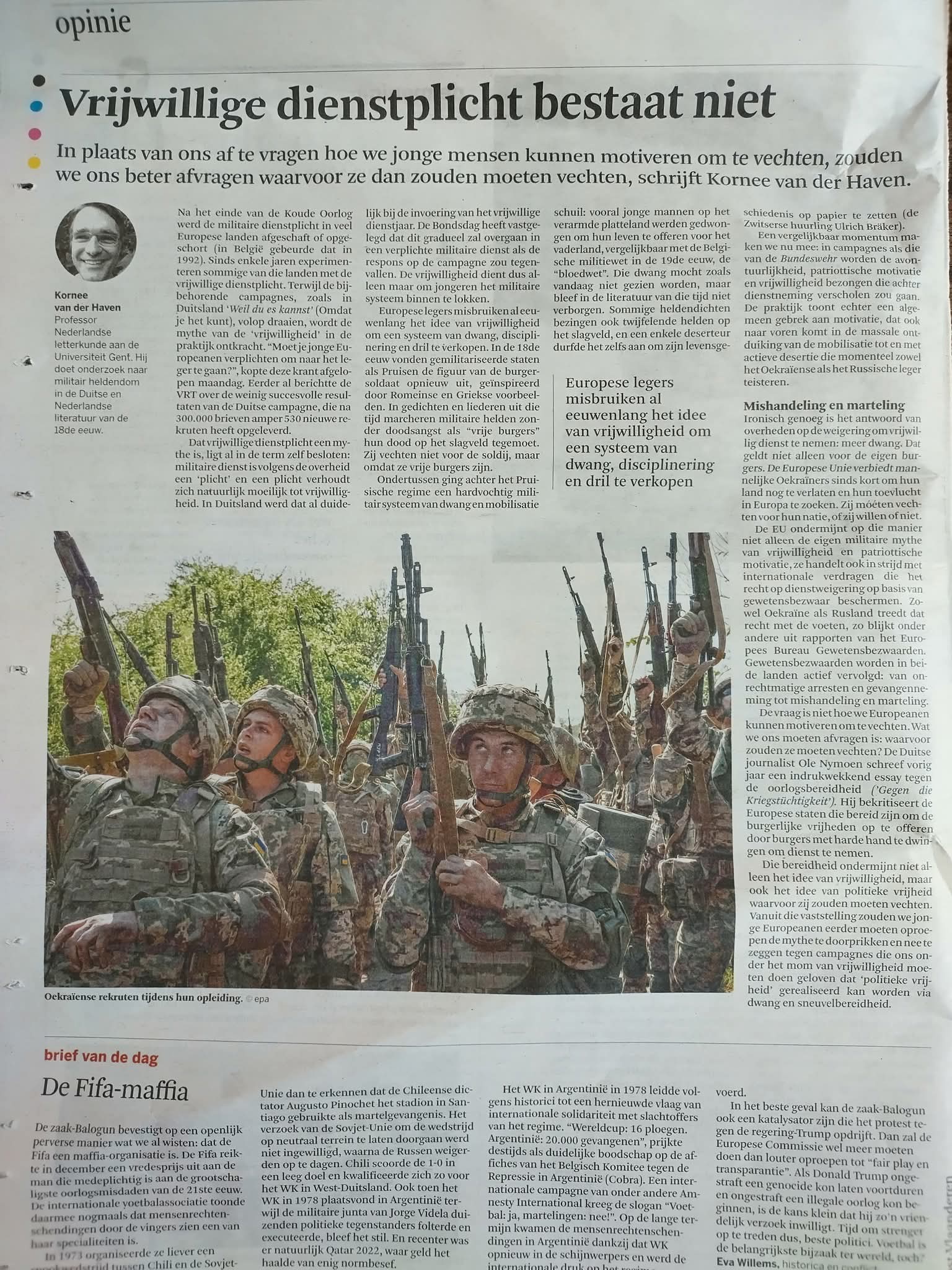
 

There’s no such thing as ‘voluntary conscription’ / Er bestaat niet zoiets als een ‘vrijwillige dienstplicht’

Kornee Van Der Haven, a member of the Flanders Quaker worship group,  recently had this article published in De Standaard newspaper…

For several years now, various European countries have been experimenting with voluntary military service following the abolition or suspension of compulsory military service after the end of the Cold War (in Belgium in 1992). Whilst the associated campaigns, such as Germany’s ‘Weil du es kannst’ (Because you can), are in full swing, the myth of ‘voluntariness’ is being debunked by the harsh reality on the ground. Last Monday, De Standaard ran the headline ‘Should young Europeans be forced to join the army?’ Earlier, the VRT had reported on the lacklustre results of the German campaign, which, after 300,000 letters, had yielded barely 530 new recruits.

The fact that voluntary conscription is a myth is inherent in the term itself: according to the government, military service is a ‘duty’, and a duty is, of course, difficult to reconcile with voluntariness. In Germany, this became clear when the voluntary service year was introduced. The Bundestag has stipulated that this will gradually transition into compulsory military service should the response to the campaign prove disappointing. Voluntary service is therefore merely a lure to draw young people into the military system.

For centuries, European armies have exploited the idea of voluntarism to sell a system of coercion, discipline and drill. The roots of this lie in the 18th century. Militarised states such as Prussia reinvented the figure of the citizen-soldier, inspired by Roman and Greek examples. In poems and songs from that era, military heroes march fearlessly towards their deaths on the battlefield as ‘free citizens’. They fight not for pay but because they are free citizens.
Meanwhile, behind the Prussian regime lay a very harsh military system of coercion and mobilisation: young men in particular, from the impoverished countryside, were forced to sacrifice their lives for ‘the fatherland’, comparable to the Belgian ‘Blood Law’ (militia law) in the 19th century. Just as today, this coercion was not to be seen, yet it remained evident in the literature of the time. Some epic poems also celebrate heroes wavering on the battlefield, and the odd Prussian deserter even dared to put his life story down on paper (the Swiss mercenary Ulrich Bräker).

We are now witnessing a similar trend: campaigns such as those run by the Bundeswehr extol the sense of adventure, patriotic motivation and voluntary commitment supposedly underlying military service. In practice, however, there is a general lack of motivation, which is also evident in the mass evasion of mobilisation, extending to active desertion, currently plaguing both the Ukrainian and Russian armies.

Ironically, the response of governments to the refusal to enlist voluntarily is: more coercion. This applies not only to their own citizens. The EU has recently banned Ukrainian men from leaving their country to seek refuge in Europe. The reason? They must fight for their nation, whether they want to or not. In doing so, the EU is not only undermining its own military myth of voluntarism and patriotic motivation, but is also acting in breach of international treaties that protect the right to conscientious objection. Both Ukraine and Russia are flouting that right, as evidenced, amongst other things, by reports from the European Bureau for Conscientious Objectors. Conscientious objectors are actively persecuted in both countries, including through unlawful arrests, imprisonment, ill-treatment and torture.

I believe the question of how we can motivate Europeans to fight is the wrong one. After all, the question that precedes it is: what should they be fighting for? Last year, Ole Nymoen wrote an impressive essay against the willingness to go to war (‘Gegen die Kriegstüchtigkeit’). He criticises European states that are prepared to sacrifice civil liberties by using heavy-handed measures to force citizens into military service. This willingness not only undermines the idea of voluntarism, but also the very notion of political freedom for which they are supposed to be fighting. Based on this observation, we should instead call on young Europeans to debunk the myth and say no to campaigns designed to make us believe that ‘political freedom’ can be achieved through coercion and a willingness to die, albeit under the guise of voluntarism.

Kornee van der Haven is a professor of Dutch literature at Ghent University. He conducts research into military heroism in 18th-century German and Dutch literature.


Quaker Statement on War in Iran & Lebanon

Quakers in Belgium & Luxembourg are deeply concerned by the bombing of Iran and Lebanon by Israel and the USA, which is breaking international law and repeating the tragic mistakes of military interventions in Iraq and Afghanistan. We know that stability and security are achieved through dialogue, diplomacy and careful long-term peacemaking. War is not the answer.

At the very centre of the Quaker faith lies the experience of the Inward Light: in every human being there is implanted an element of God’s own Spirit and divine energy. Known to Friends as “that of God in everyone”, this element forms the basis the Quaker way of life of which non-violence is an essential expression. We totally oppose all wars, all preparation for war, all use of weapons and coercion by force, and all military alliances. No end could ever justify such means.

We endorse the recent statements on this war by Britain Yearly Meeting and the American Quaker Friends National Committee on Legislation


BLYM Supplement to Quaker Faith & Practice

We are delighted offer to you the link to the Supplement from Belgium and Luxembourg Yearly Meeting, to Quaker Faith and Practice of Britain Yearly Meeting.

Through many months of work some in our worship groups have compiled this compendium of material particularly relevant to Belgian and Luxembourger Friends. It was adopted at our June 2024 Meeting for Business, and has been distributed on-line in original and in machine translation to Flemish and French.

In a sense this supplement is part of the coming of age of Belgium and Luxembourg Quakers as a Yearly Meeting, for we have not had such a text of our own in the past, and still appreciate and rely on those of other Yearly Meetings including the ‘Red Book” of Britain Yearly Meeting.

We hope that you enjoy reading and using this supplement. As with all Quaker Faith and Practice texts, it is to be adapted and updated from time to time to continue to reflect our shared experience.

You can find the English version here

You can find the French version here

You can find the Dutch version here

Quaker statement on Donald Trump’s proposal to take over Gaza

5 February 2025

children
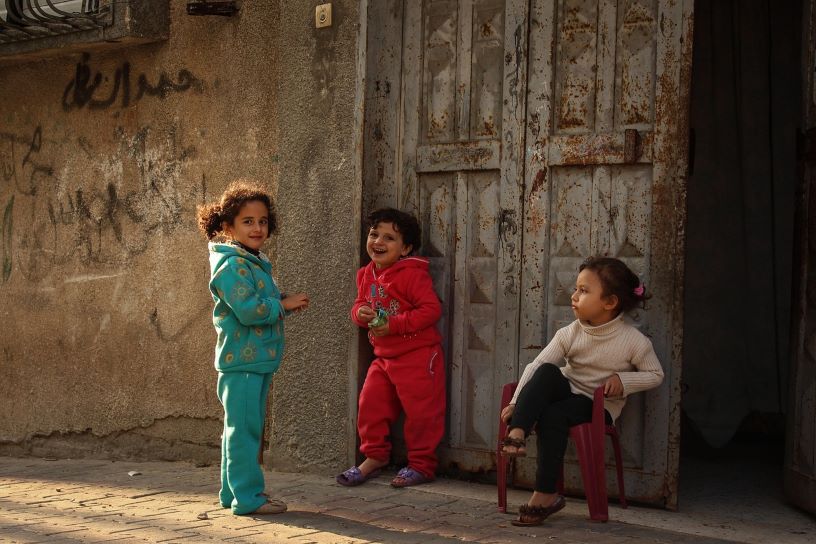
Quakers are horrified by Donald Trump’s proposal to take over and own Gaza and ethnically cleanse two million Palestinians, photo credit: Hosny Salah from Pixabay

Quakers are horrified by Donald Trump’s proposal to “take over” and “own” Gaza and ethnically cleanse two million Palestinians.

These proposals come after a decades-long occupation which has already crossed numerous legal and moral red lines. A further “announcement” on the West Bank is expected within the next four weeks.

These threats must be taken seriously. Any attempt to implement them would be a grave violation of international law. Any move by the UK government or others to normalise or enable them would be a grave violation of international law.

Quakers and partners are actively engaged in the region and in the UK to end our government’s complicity and end the occupation of Palestine.

Find out more about our work to bring about a just peace in Palestine and Israel