
 Kornee Van Der Haven, a member of the Flanders Quaker worship group, recently had this article published in De Standaard newspaper…
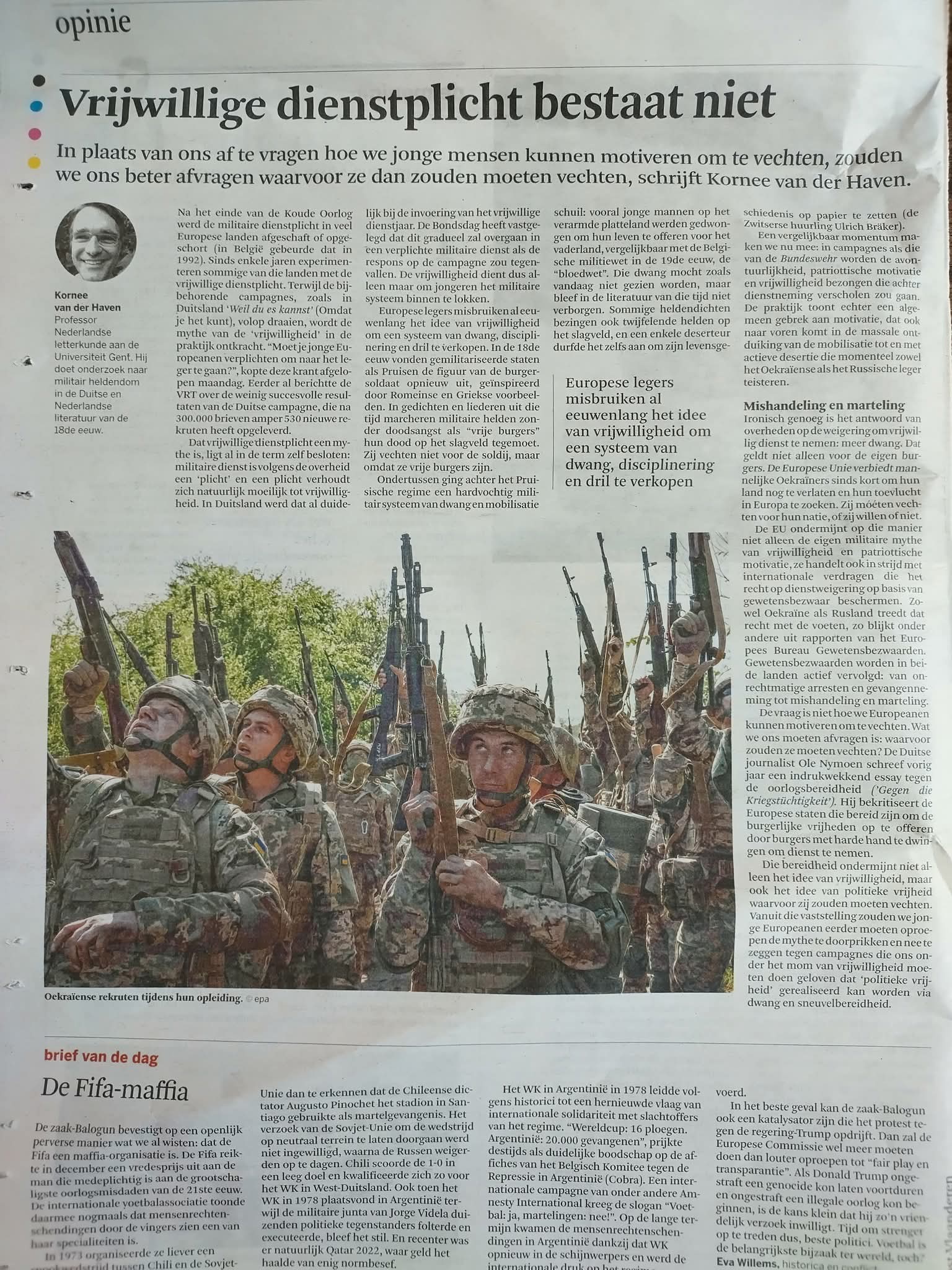
For several years now, various European countries have been experimenting with voluntary military service following the abolition or suspension of compulsory military service after the end of the Cold War (in Belgium in 1992). Whilst the associated campaigns, such as Germany’s ‘Weil du es kannst’ (Because you can), are in full swing, the myth of ‘voluntariness’ is being debunked by the harsh reality on the ground. Last Monday, De Standaard ran the headline ‘Should young Europeans be forced to join the army?’ Earlier, the VRT had reported on the lacklustre results of the German campaign, which, after 300,000 letters, had yielded barely 530 new recruits.
The fact that voluntary conscription is a myth is inherent in the term itself: according to the government, military service is a ‘duty’, and a duty is, of course, difficult to reconcile with voluntariness. In Germany, this became clear when the voluntary service year was introduced. The Bundestag has stipulated that this will gradually transition into compulsory military service should the response to the campaign prove disappointing. Voluntary service is therefore merely a lure to draw young people into the military system.
For centuries, European armies have exploited the idea of voluntarism to sell a system of coercion, discipline and drill. The roots of this lie in the 18th century. Militarised states such as Prussia reinvented the figure of the citizen-soldier, inspired by Roman and Greek examples. In poems and songs from that era, military heroes march fearlessly towards their deaths on the battlefield as ‘free citizens’. They fight not for pay but because they are free citizens.
Meanwhile, behind the Prussian regime lay a very harsh military system of coercion and mobilisation: young men in particular, from the impoverished countryside, were forced to sacrifice their lives for ‘the fatherland’, comparable to the Belgian ‘Blood Law’ (militia law) in the 19th century. Just as today, this coercion was not to be seen, yet it remained evident in the literature of the time. Some epic poems also celebrate heroes wavering on the battlefield, and the odd Prussian deserter even dared to put his life story down on paper (the Swiss mercenary Ulrich Bräker).
We are now witnessing a similar trend: campaigns such as those run by the Bundeswehr extol the sense of adventure, patriotic motivation and voluntary commitment supposedly underlying military service. In practice, however, there is a general lack of motivation, which is also evident in the mass evasion of mobilisation, extending to active desertion, currently plaguing both the Ukrainian and Russian armies.
Ironically, the response of governments to the refusal to enlist voluntarily is: more coercion. This applies not only to their own citizens. The EU has recently banned Ukrainian men from leaving their country to seek refuge in Europe. The reason? They must fight for their nation, whether they want to or not. In doing so, the EU is not only undermining its own military myth of voluntarism and patriotic motivation, but is also acting in breach of international treaties that protect the right to conscientious objection. Both Ukraine and Russia are flouting that right, as evidenced, amongst other things, by reports from the European Bureau for Conscientious Objectors. Conscientious objectors are actively persecuted in both countries, including through unlawful arrests, imprisonment, ill-treatment and torture.
I believe the question of how we can motivate Europeans to fight is the wrong one. After all, the question that precedes it is: what should they be fighting for? Last year, Ole Nymoen wrote an impressive essay against the willingness to go to war (‘Gegen die Kriegstüchtigkeit’). He criticises European states that are prepared to sacrifice civil liberties by using heavy-handed measures to force citizens into military service. This willingness not only undermines the idea of voluntarism, but also the very notion of political freedom for which they are supposed to be fighting. Based on this observation, we should instead call on young Europeans to debunk the myth and say no to campaigns designed to make us believe that ‘political freedom’ can be achieved through coercion and a willingness to die, albeit under the guise of voluntarism.
Kornee van der Haven is a professor of Dutch literature at Ghent University. He conducts research into military heroism in 18th-century German and Dutch literature.
 English